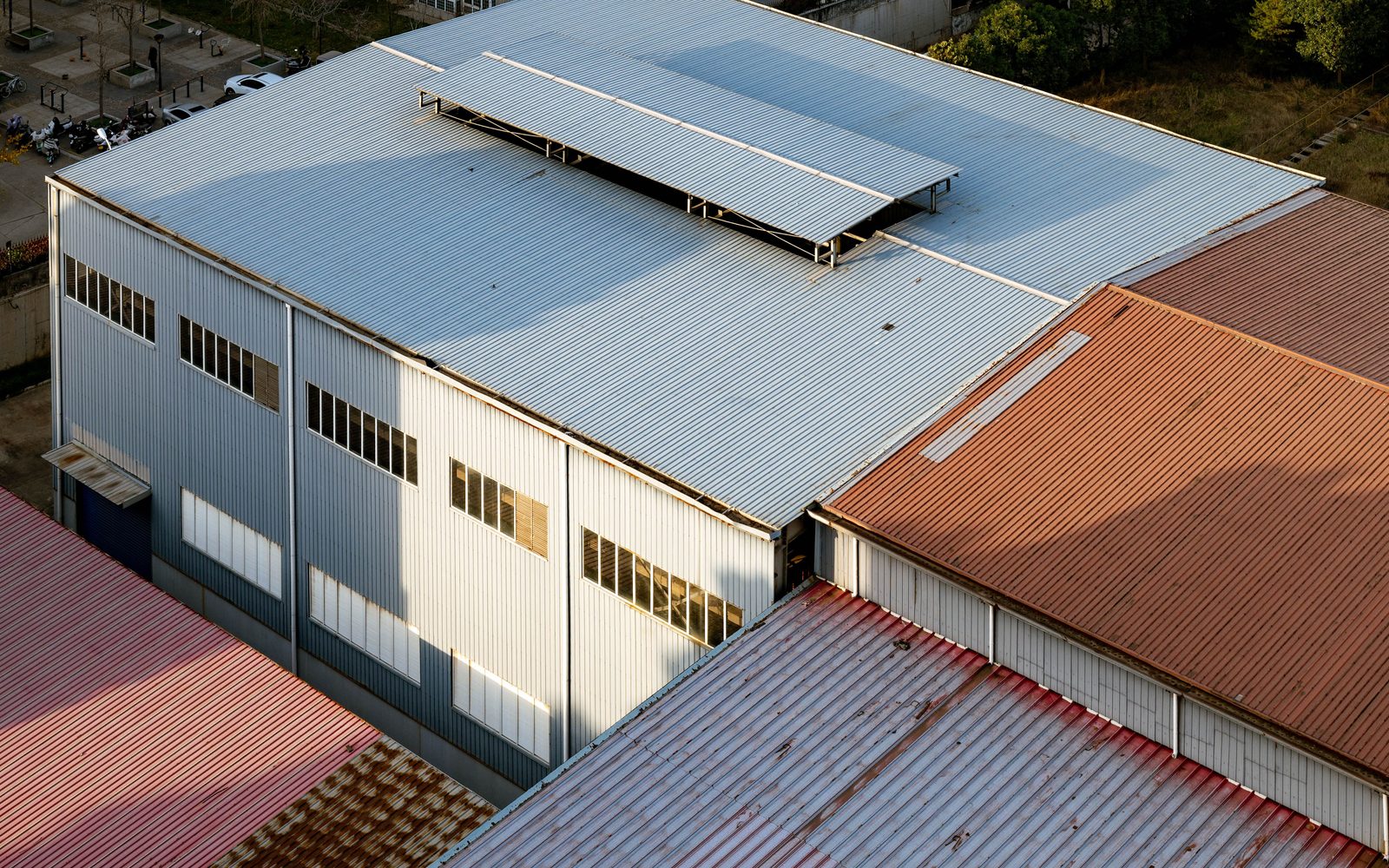
A commercial roofing system is the full assembly on top of the deck: insulation, cover board, the waterproof membrane and the flashings that seal every edge and opening. Choosing a system means matching that assembly to the building, the climate and how long you plan to own it.
The word system is doing real work in that sentence. Owners shop for a membrane, because the membrane has a brand name and a price per square foot. Roofs fail as assemblies. The insulation decides the energy performance and holds the water when something goes wrong, the cover board decides how the roof survives foot traffic, the attachment method decides how it behaves in wind, and the flashings decide whether it leaks. The membrane is the part you can see, not the part that decides the outcome.
The six systems you will see most
| System | What it is | Best fit |
|---|---|---|
| TPO | Single ply thermoplastic sheet with heat welded seams | Warehouses, retail, sunny climates where a white surface cuts cooling load |
| EPDM | Synthetic rubber sheet, glued, fastened or ballasted | Large simple roofs, colder climates |
| PVC | Single ply thermoplastic that resists oils and chemicals | Restaurants, labs, roofs with grease exhaust |
| Modified bitumen | Asphalt sheets modified with polymers, torched, cold applied or self adhered | Roofs with heavy foot traffic |
| Built up (BUR) | Alternating layers of bitumen and reinforcing plies, often with gravel | Buildings that want redundancy and durability |
| Metal | Standing seam or through fastened panels | Sloped commercial roofs and long ownership periods |
Two of those rows deserve a note. PVC and TPO look similar on a roof and are often discussed as interchangeable, but they are different chemistries: PVC holds up to oils, greases and many chemicals that will degrade TPO, which is why it is specified over kitchens and process plant. And metal is the one system on the list that is not a membrane at all. It sheds water by slope and overlap rather than by sealing a surface, so it belongs on roofs with real pitch and it fails in a different way, at fasteners and laps rather than at seams.
How to choose
Start with the roof itself. Slope, drainage, the number of rooftop units and penetrations, and how often people walk on it all narrow the field. Then look at climate. Heat and ultraviolet light punish dark surfaces, while freeze and thaw cycles punish seams. Finally, look at ownership. A building you will sell in five years needs a different answer than one you will hold for twenty.
In practice the decision follows a short sequence, and each step removes options.
- What does the building do? Grease, chemical exhaust, heavy service traffic or a fire rating requirement will eliminate systems outright before anything else is considered.
- What is the slope? Genuinely flat roofs rule out metal. Sloped roofs open it up.
- What can the structure carry? Ballast and built up roofing are heavy. An older deck may not take them.
- What does the climate do? Hail, high wind, deep snow and extreme ultraviolet exposure each favor different materials and, just as importantly, different attachment.
- How long will you own it? A longer hold justifies paying for redundancy and thickness now.
- Who will install it? The best system in the region is the one good local crews build every week. An exotic specification that nobody nearby installs well is a risk, not an upgrade.
Attachment matters as much as the membrane
How the system is held down changes the price, the wind performance and the way the roof ages. Mechanically fastened roofs are screwed through to the deck and are quick and economical, but the sheet flutters between fastener rows in wind. Fully adhered roofs are bonded across the whole surface, sit flat and generally do better on tall or exposed buildings. Ballasted roofs are held by stone or pavers, which is cheap to install and awkward to inspect.
This is a genuine difference in what you are buying rather than an upsell, and it is one of the main reasons two bids for the same building arrive at different numbers. Our guide to replacement cost sets out how it shows up in a bid.
Where each system tends to fail first
Knowing the usual failure mode is more useful than knowing the marketing claim, because it tells you what to inspect and what to insist on in the specification.
| System | Usual first failure | What prevents it |
|---|---|---|
| TPO | Seam welds opening, and punctures in thin sheet | Thickness, a cover board, probing every seam at handover |
| PVC | Plasticizer loss over many years, leaving the sheet brittle | Quality of the sheet specified, and keeping ponding off it |
| EPDM | Shrinkage pulling flashings away at parapets and curbs | Correct detailing at upstands, and inspecting the perimeter |
| Modified bitumen | Laps opening, and splits over movement in the deck | Proper lap width, and expansion joints built rather than roofed over |
| Built up | Blistering and ridging, and gravel migrating into drains | Dry construction, and drain maintenance |
| Metal | Fasteners backing out, and leaks at laps and penetrations | Concealed clip systems, and an annual check of exposed fixings |
None of those is a reason to avoid a system. They are the items to name when you ask a contractor how they will build and maintain what they are proposing, and the items an honest inspector will look at first.
The warranty is part of the system you are buying
Manufacturer warranties are written against a specification, and that specification is usually stricter than the minimum that would pass a building inspection. Longer terms require particular thicknesses, particular cover boards, particular fastening patterns and particular details, and they require the installer to hold that manufacturer’s approval.
That is why the warranty term is not an add on to the price. It changes the assembly. A twenty year term and a ten year term on the same building are two different roofs, and comparing the prices without comparing the specifications tells you nothing.
Read what the warranty actually covers before it decides anything for you. Materials only warranties replace the sheet and leave you paying the labor to fit it. Systems warranties that cover materials and labor are worth considerably more, and they normally carry inspection obligations that you have to meet for the cover to survive.
What matters more than the material
Most commercial roof failures start at flashings, seams and penetrations, not in the middle of the membrane. A mid priced system installed well will outperform a premium system installed poorly. Ask any contractor how they detail curbs, drains and parapet walls, and ask to see the manufacturer’s warranty terms in writing.
Three things move a roof’s life more than the product on the specification:
- Detailing. Hand built work at every curb, pipe, wall and drain, done by whoever was on the roof that day.
- Drainage. Water that leaves quickly cannot damage anything. Water that sits does, whatever it is sitting on.
- Maintenance. Clear outlets, closed penetrations and small repairs done early. The cheapest work on any roof, and the first thing dropped from a budget.
A contractor who proposes the same system on every building is not specifying, they are selling what they buy cheapest. The useful conversation starts when someone walks your roof and explains which of the six systems your building rules out and why.
Next steps
Read our guide to flat roofs for low slope details, or see what drives commercial roof replacement cost. When you are ready to compare bids, our guide to choosing a contractor lists the questions to ask.
Common questions
What is the most common commercial roofing system?
Single ply membranes, and TPO in particular, cover most new low slope commercial roofs in the United States.
- They arrive in wide rolls, install quickly and weigh little
- Cheaper in labor than multi layer systems, so they dominate large simple roofs
- Common is not automatically correct: the whole roof rests on hand welded seams
- Grease from kitchen exhaust wants PVC, heavy foot traffic often modified bitumen
- Roofs full of small penetrations can suit a layered system worked around obstacles
A well welded TPO roof is excellent and a badly welded one opens at the seams long before the material ages. Ask a contractor why they are proposing what they propose, and listen for reasons about your building.
What is the difference between single ply and multi ply roofing?
Single ply is one layer of factory made membrane, such as TPO, PVC or EPDM, joined at the seams. Multi ply is built on the roof from several overlapping layers, as in modified bitumen or built up roofing.
- A single ply roof has little jointing across the field, so most is factory quality
- Its vulnerability is concentrated in the seams and the hand built details
- A multi ply roof has joints everywhere but also redundancy between plies
- Redundancy costs weight, installation time and labor
- Built up roofs are costly to tear off later because of sheer weight
The choice is genuinely a trade between speed and cost on one side and redundancy and durability on the other. With single ply there is no second line of defense behind a bad seam.
Do I need a cover board under the membrane?
On most commercial roofs, yes, and it is one of the cheapest upgrades on a specification.
- A thin dense board over the insulation and under the membrane
- It gives the membrane a firmer surface to bond to than insulation facers
- It spreads foot traffic so the insulation below does not compress and dent
- It adds fire and hail resistance to the assembly
- Many manufacturer warranties require one or give better terms with one
Insulation on its own is soft, and a dent becomes a low spot that collects water where people keep walking. Boards range from gypsum based to high density polyisocyanurate and cementitious panels, so ask whether the bid includes one and, if not, why.
What membrane thickness should I specify?
Thicker than the minimum, in almost every case. The thinner options exist to hit a price, not because they suit a commercial building.
- Thickness buys puncture resistance, weld strength and years of weathering
- Only part of a thermoplastic sheet sits above the reinforcing scrim
- That upper portion is what sun, hail and foot traffic consume
- Once the scrim is exposed, the roof is finished
- Warranty terms are usually tied to thickness, measured in mils
Ask for thickness named in the bid by product and mils, because it is the easiest place to shave a price invisibly. Specify thicker material where the roof takes abuse: walkway routes, plant areas and roofs exposed to hail.
Is a roof coating a roofing system or just a repair?
It is a restoration, which is a real category but not a replacement. A liquid applied coating renews the surface of a roof that is still sound.
- It covers minor weathering and reinforces details with fabric where needed
- On many roofs it resets a manufacturer warranty
- It cannot fix anything below the surface it is painted onto
- Over wet insulation it seals the water in and the decay continues unseen
- Over a membrane already splitting or shrinking across the field it is decoration
Over a dry, well detailed roof it buys real years for a fraction of replacement cost. The deciding evidence is a moisture survey and a detail inspection, not a sales visit, so ask for the survey, the warranty conditions and what happens at replacement.