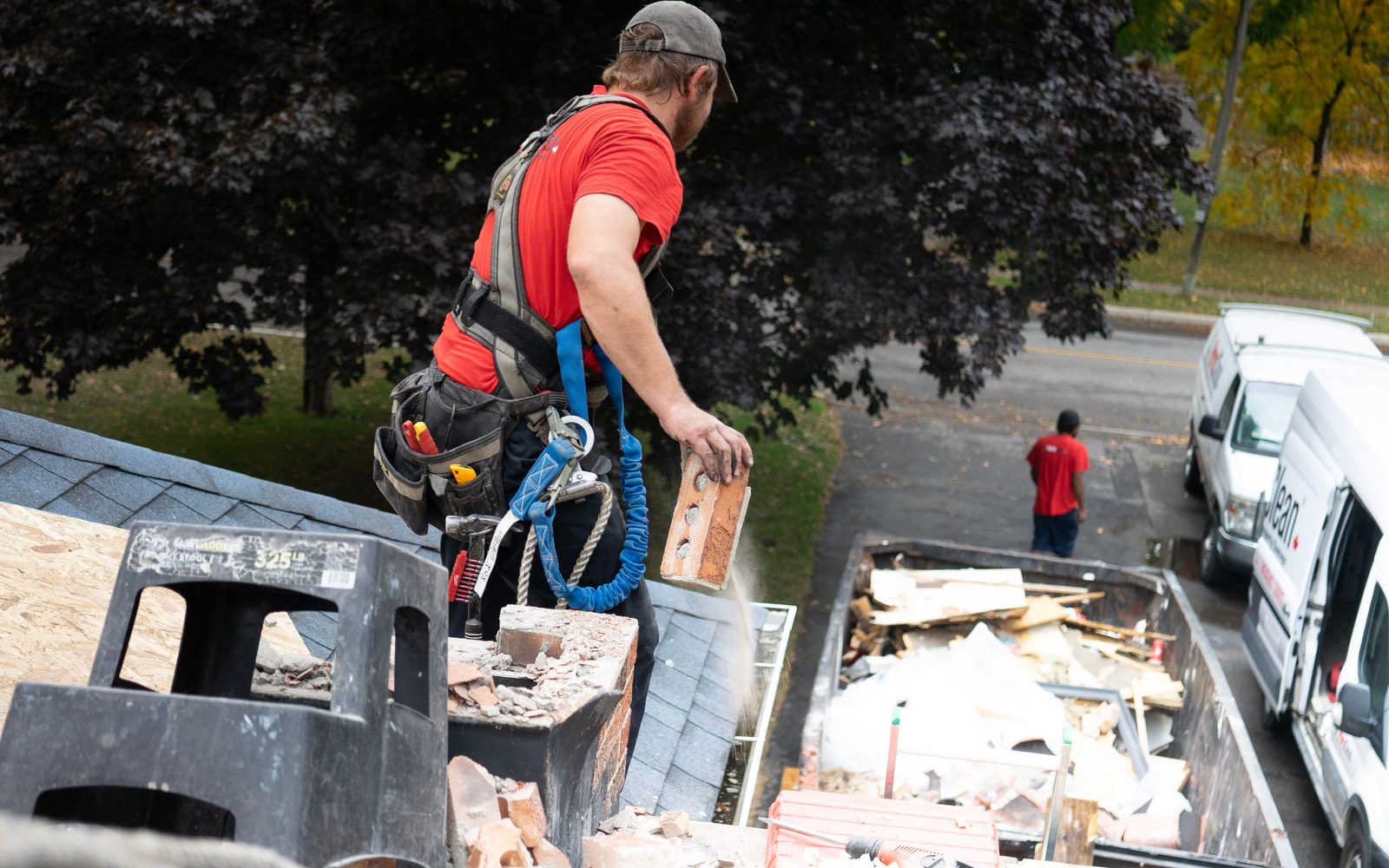
Commercial roof replacement means removing or covering the existing roof and installing a new system from the deck up. It is one of the largest capital projects a building owner faces, so the decision deserves evidence, not a sales pitch.
The evidence is not difficult to get. A moisture survey, a handful of core samples and an honest look at the deck will tell you whether the roof is finished or whether it has years left in it. What makes owners overpay is rarely the roof itself. It is starting the conversation the week a tenant reports water, when there is no time to test anything, no time to compare bids, and no leverage at all.
Signs a roof needs replacing
- Leaks in several areas that keep returning after repairs
- Wet insulation across a large share of the roof, confirmed by a moisture survey
- Membrane that has split, shrunk or lost its surfacing across the field
- Repair costs that now approach a meaningful share of replacement cost
If only one of these is true, ask whether repair or restoration could buy time first. A roof that leaks in one place is not a failed roof. It is a roof with a failed detail, and detail repairs are cheap compared with replacement.
The line worth holding in your head is the difference between a leak and a failure. A leak is local and traceable: a split at a curb, a cracked drain bowl, a lifted edge. A failure is systemic. The membrane has lost its plasticizers and gone brittle everywhere, or the insulation is wet across whole bays, or the seams are opening in the field rather than at one bad weld. Local problems get repaired. Systemic problems get replaced, because every repair on a failing roof buys less time than the one before it.
What a moisture survey actually tells you
A survey maps where the insulation is wet. That is the single most useful piece of information in the whole project, and it is cheap relative to what it decides.
There are three common methods. Infrared scanning reads the heat that wet areas hold after sunset, so it works on a clear evening after a sunny day and it covers a large roof quickly. Capacitance meters read moisture through the membrane on a grid, which is slower but works in conditions that defeat infrared. Nuclear gauges give a reading at set points and are usually used to confirm what the other two suggest.
All three are indirect, which is why any survey worth paying for ends with core cuts. A core is a small plug taken through the whole assembly and patched afterwards. It shows you the layers, how many roofs are there, what the insulation is, whether it is wet, and what the deck looks like. A contractor who prices a replacement without taking a single core is guessing at the two items most likely to blow the budget.
Tear off or overlay
A tear off removes everything down to the deck. It costs more in labor and disposal, but it exposes deck damage and resets the roof completely. An overlay installs the new system over the old one. It can save money when the existing roof is dry, and codes allow another layer. Every existing layer adds weight and disposal cost to the next replacement, which buyers and lenders will notice.
Three things decide it, and none of them is the price.
Moisture. Wet insulation under an overlay stays wet. It keeps working on the deck and the fasteners where nobody can see it, and it takes the new roof down with it.
Weight. Roof decks are designed for a load. Another layer of insulation and membrane adds dead weight permanently, and in snow country that sits on top of a live load the structure also has to carry. On older buildings this is a question for a structural engineer, not for the roofing crew.
Code. Most jurisdictions limit how many roof layers a building may carry. A roof already carrying two will have to come off whatever you would prefer.
There is a resale argument too. A building sold with three roofs on it carries a known future cost, and an informed buyer prices that in. Owners who plan to hold the asset usually find the tear off is the cheaper decision by the time they sell.
The replacement process
- Assessment: core samples, moisture survey and a deck check
- Specification: system, insulation, drainage fixes and flashing details in writing
- Bids: at least three, compared on the same scope
- Scheduling: phases planned around tenants, weather and rooftop equipment
- Installation: the building stays watertight at the end of each day
- Closeout: manufacturer inspection, warranty registration and as built records
The step owners skip is the second one. If you send three contractors to the roof and ask each for a price, you will get three different roofs at three different prices and no way to compare them. Write the specification first, or have a consultant write it, and then ask everyone to bid the same thing. The specification is what turns a pile of quotes into a decision.
What happens on the roof, day by day
A replacement is not one operation. It is the same short sequence repeated across the roof, section by section, and knowing the sequence tells you whether what you are watching is going well.
The crew sets up access and a debris route first, usually a chute or a crane drop to a skip. Then they strip a defined area, often the size the team can finish in a day. The deck is swept and inspected, and any damaged sheets are marked for replacement. A vapor barrier goes down where the design calls for one. Insulation follows, in two staggered layers where the design is good, because staggered joints stop heat and water traveling straight through. A cover board goes over the insulation to give the membrane a firm, fire resistant surface. Then the membrane, fastened or adhered as specified, seamed and rolled. Finally the details: edge metal, curb flashings, pipe boots, drain clamps.
At the end of that day the new work is tied into whatever remains of the old roof with a temporary seal. That join is where a badly run job leaks, and it is worth asking to see.
The deck, and why nobody can price it in advance
The deck is the one item that cannot be quoted honestly before the roof is open. Steel deck rusts from above where water has been sitting, concrete deck can be sound but saturated, and timber deck rots. None of it is visible until the existing roof comes off.
This is why the best protection on a bid is a unit rate rather than an allowance. A rate per sheet of steel deck replaced, or per square foot of timber, turns the unknown into arithmetic. You pay for what is found, at a price agreed before anyone had an incentive to find more. A contractor who refuses to give unit rates is reserving the right to name a number at the worst possible moment.
Planning around the building
Rooftop equipment may need disconnecting and lifting. Tenants need notice about noise, odors and parking. Debris removal depends on site access, and poor access adds labor and hauling time. See what drives replacement cost, and read how to choose a contractor before you sign.
Walk the ground level before the job starts and decide three things: where the skips go, where the crew parks, and which route the debris takes. Every one of them affects a tenant. Then agree the hours. Noise over a call center at nine in the morning is a different problem than noise over a warehouse, and some buildings are better served by evening or weekend work even though it costs more.
Rooftop units deserve their own conversation. Anything sitting on a curb has to be dealt with, and units that sit on the roof surface on sleepers may need raising to meet the new flashing heights. Extra insulation raises the roof level, which means door thresholds, wall flashings and equipment supports all move too. A specification that ignores this produces change orders in week two.
Choosing the system while you are at it
A replacement is the only moment you can change what is on the building without paying twice, so it is worth asking whether the system that just failed is the right one to put back.
Ask what actually killed it. A membrane destroyed by kitchen grease says specify something that resists it. Seams that opened under constant foot traffic say the roof needs a walkway system or a tougher surface, not a thinner sheet at a better price. Insulation that went wet from the inside says the building needs a vapor barrier that it never had. A roof that failed because nobody ever cleared the drains says the problem is maintenance, and a new membrane will not fix it.
Ownership horizon matters as much as the building. A roof on an asset you intend to sell in three years is a different purchase than a roof on a building your business will occupy for twenty. Our guide to roof systems sets out how each assembly is built and which buildings it suits.
Before the crew arrives
- Photograph the interior. Ceilings, walls and stock under the roof, dated. If something is damaged during the work you will want a record of what it looked like before.
- Agree access and storage in writing. Where materials are laid down, where skips stand, which doors the crew uses, and who holds keys.
- Confirm the insurance certificates came from the insurer rather than the contractor, and that they are current for the whole schedule.
- Warn every tenant in writing, with dates, hours and a named contact.
- Book the mechanical trade for disconnecting and resetting rooftop units, and put that date in the same schedule as the roofing work.
- Clear the roof. Old aerials, abandoned conduit, dead equipment and redundant curbs all cost money to flash around. Anything that is not in use should come off rather than be roofed into the new assembly for another twenty years.
Where replacements go wrong
- Scope written by the bidder. If each contractor defines the job, the cheapest one has simply assumed the least.
- No survey. Without a moisture map you are replacing a roof you have not measured, and possibly replacing more of it than you need to.
- Drainage carried forward. A roof that ponded before will pond again unless the new design fixes falls, adds drains or both. Replacing a membrane over a drainage fault buys a new roof with the old problem.
- Details rushed at the end. Flashings are hand built and they are where roofs leak. A schedule that leaves them to the last two days is a schedule that will leak.
- Warranty never registered. Manufacturer warranties require an inspection and registration. Miss it and you have a receipt, not a warranty.
Next steps
Understand what moves the number before you go to market: our guide to replacement cost explains the line items and the questions that expose a thin scope. If you are still deciding what to install, compare roof systems first, and when you are ready to go out to bid, read how to choose a contractor.
Common questions
How long does a commercial roof replacement take?
It depends on size, access, weather and how much of the building stays in use. A straightforward warehouse roof goes faster than an occupied building with heavy rooftop plant.
- On an occupied roof the crew works small areas and closes each one nightly
- Ask for the schedule in writing, as a sequence rather than one end date
- It should name the daily work area and the order sections come off
- It should name when units are disconnected and reset, and the weather days
- Deck damage nobody expected stops the new roof going down
A crew with no float will either work through conditions that compromise the roof or blow the date. The other reliable delay is rooftop equipment, so book the mechanical contractor before the tear off starts, not after.
Do tenants have to move out during a roof replacement?
Almost never. Commercial roofs are replaced over occupied buildings routinely, and the work happens above the deck rather than inside the space.
- Tenants will hear the work and may smell adhesives or asphalt through air intakes
- Parking and loading areas lose room to skips and lifts
- Write before the job with dates, hours, the weekly work area and who to call
- Laboratories, kitchens, data rooms and medical suites may need intakes shut down
- Sensitive equipment under the deck may need covering, because tear off shakes dust loose
Tenants who know what is coming tolerate a great deal; tenants who find out when the ceiling tiles rattle do not. Raise the sensitive spaces at bid stage so the method and the price reflect them rather than becoming a change order.
What time of year is best for a commercial roof replacement?
Mild, dry and settled weather is what matters, not the month. In most of the country that points at late spring through early fall.
- Most membranes and adhesives have temperature limits for installation
- Seams weld and bond better in warm conditions, and the deck has to be dry
- Everyone wants the same window, so good crews book months ahead
- Cold weather work needs products and adhesives rated for the conditions
- It is slower, because nothing can sit open, so it costs more
Planning a year out is worth more than picking a perfect month: it buys a slot early in the season and time to survey, specify and compare bids. If the roof is actively failing, a poor season still beats another winter of interior damage.
Who is responsible if it rains during the tear off?
The contractor is, and the contract should say so plainly. Water entering through an open tear off is their liability, not yours.
- A competent crew opens no more roof than it can close that day
- They watch the forecast and keep temporary materials on site to seal an edge
- Work is sequenced: strip, dry in the deck, insulation, membrane, then tie in
- The temporary cut off at the join is the weak point, rebuilt every day
Name the party responsible for water in the work area, require the building watertight at the end of each day, and require notice if a section stays open. Ask for the insurance certificate from the insurer, so a policy sits behind the promise.
What should I receive when the roof replacement is finished?
A closeout package, not a handshake. The documents are what the warranty and every future decision rest on.
- The manufacturer warranty registered in your name, and the workmanship warranty in writing
- The final inspection report from the manufacturer technical representative
- As built drawings showing the assembly and details, for the first new penetration
- A list of the products actually installed, with batch information
- A maintenance schedule, because warranties requiring inspections lapse quietly without them
The inspection report proves the roof was built to the specification the warranty depends on, and it usually lists items to correct first, so chase them rather than filing it. Ask for photographs of every flashing detail before the final surfacing goes on.