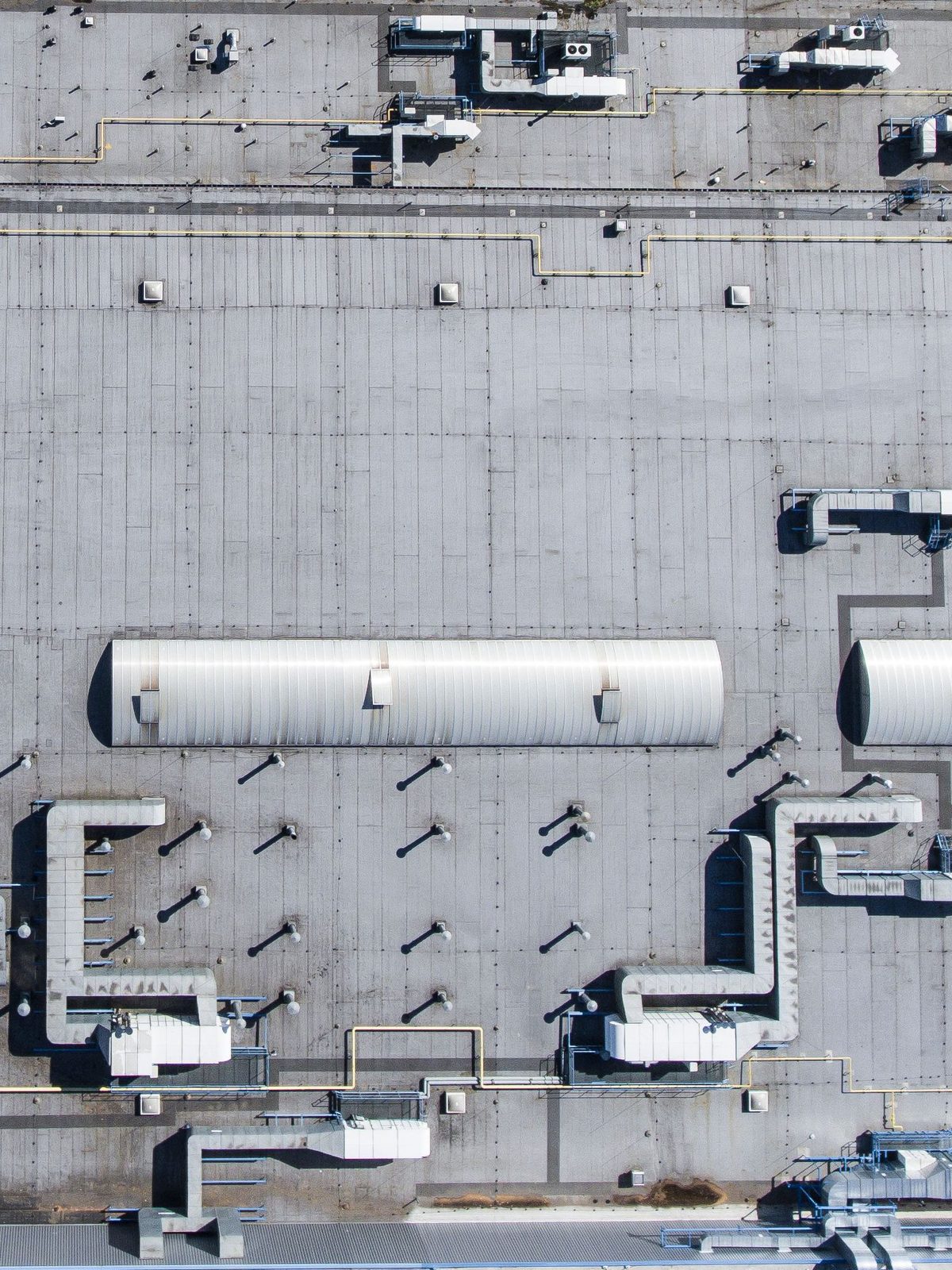
A flat roof is a low slope roof designed to shed water slowly toward drains rather than quickly off an edge. Almost every warehouse, shopping center and office building uses one, because it is the most efficient way to cover a large footprint and it gives mechanical equipment a place to sit.
That design choice has a consequence owners feel for the whole life of the building. A pitched roof is forgiving, because gravity moves water off it fast enough to cover for imperfect workmanship. A flat roof is not forgiving. Water stays on it long enough to find any weakness, so the roof only works if the waterproofing is continuous and the drainage does its job. Almost everything worth knowing about flat roofs follows from that.
Common flat roof materials
- TPO and PVC: single ply thermoplastic sheets with welded seams, usually white
- EPDM: a rubber membrane, usually black, known for flexibility
- Modified bitumen: layered asphalt sheets that handle foot traffic well
- Built up roofing: several plies of bitumen and felt, often topped with gravel
- Coatings: liquid applied layers used to restore an existing roof rather than replace it
Our roof systems guide compares each in detail.
The important distinction inside that list is between sheet systems and layered systems. TPO, PVC and EPDM arrive as large rolls, so most of the roof has no joint at all and the risk concentrates at the seams and the details. Modified bitumen and built up roofs are assembled from overlapping plies, so there are joints everywhere, but there is also redundancy: a defect in one ply is covered by the next. Neither approach is better in the abstract. One depends on the quality of a few critical welds, the other on the consistency of many overlaps.
What is actually under the membrane
Owners think of a flat roof as the sheet they can see. The sheet is the thinnest part of it, and it is not what keeps the building warm, quiet or standing up.
From the top down, a typical commercial flat roof is:
- The membrane, the waterproof layer, anything from a single sheet measured in mils to several plies of bitumen.
- A cover board, a thin, dense board that gives the membrane a firm surface, protects the insulation from foot traffic and adds fire resistance.
- Insulation, usually rigid boards, ideally in two layers with staggered joints so heat and water cannot travel straight through a gap.
- A vapor barrier in some assemblies, on the warm side of the insulation, stopping moist indoor air from reaching the cold layers and condensing there.
- The deck, which carries everything: steel, concrete, timber or occasionally cementitious panels.
This matters because the way a flat roof fails is usually a story about the layers rather than the sheet. Water gets through a detail, soaks the insulation, and the insulation holds it against the deck for years. By the time the ceiling is stained, the damage is under a roof that still looks intact from above.
Drainage is everything
Water that sits on a flat roof finds every weakness. Ponding forms where the deck sags, where insulation has compressed, or where drains clog with debris. Clearing drains, gutters and scuppers after storms and at the change of seasons is the cheapest roof maintenance there is.
There are three ways water leaves a flat roof, and most buildings use more than one.
| Outlet | How it works | What goes wrong |
|---|---|---|
| Internal drains | Water runs to low points and leaves through pipes inside the building | Blockages back up onto the roof; a leak at the drain bowl runs inside the building where nobody sees it |
| Scuppers | Openings through the parapet let water out at the edge | Undersized or set too high, so water ponds before it reaches them; the outlet flashing is a classic leak point |
| Gutters | Water runs to an edge and into a hung or built in gutter | Debris, frozen outlets, and on built in gutters a lining that fails inside the roof structure |
Every roof should also have an overflow: a second drain set slightly higher, or an overflow scupper. It is there for the day the primary outlet blocks during a storm. Water is heavy, and a parapet wall will hold a great deal of it on a roof that was never designed to carry the load. Check that overflows exist, and check that nobody has sealed them up to stop a draft.
Where flat roofs fail
Leaks rarely start in the open field of the membrane. They start at transitions: rooftop unit curbs, pipe penetrations, parapet walls, expansion joints and edge metal. Inspections should spend most of their time on these details.
The reason is simple. The field of the roof is machine made material laid by a crew doing the same thing for hours. The details are hand built, one at a time, often by the person who is left at the end of the job. Every change of direction, every object coming through the sheet and every join between two materials is a decision someone made on the roof.
The details worth naming, because these are where the money goes:
- Curbs under rooftop units, where the flashing has to turn up the curb and be secured under a counterflashing
- Pipe penetrations, which move as they heat and cool and eventually open the boot around them
- Parapet walls, where the roof turns vertical and where coping joints above can let water in behind the flashing
- Drain assemblies, where the membrane is clamped into the bowl and where a loose clamping ring leaks straight into the building
- Perimeter edge metal, which takes the highest wind pressure on the whole roof and is the usual starting point for a peel failure
- Expansion joints, which are supposed to move and which fail when they are roofed over as if they were not
Wind uplift starts at the edges
Wind does not press down on a flat roof. It accelerates over the parapet and creates suction above the surface, and that suction is strongest at the corners, then along the perimeter, and weakest in the middle of the field. This is why roofing standards call for more fasteners or more adhesive in corner and edge zones than in the field, and why a specification that treats the whole roof identically is not a specification at all.
It is also why edge metal matters more than its cost suggests. Almost every large wind failure on a commercial roof starts at an edge or a corner: the metal lifts, the membrane behind it is exposed, air gets underneath, and the sheet peels back across the roof in seconds. The remedy is unglamorous. Specify edge metal to a recognized standard, fix it as the manufacturer requires, and inspect it. Loose, rattling or lifting edge metal is the single most urgent thing you can find on a roof walk.
Putting solar and equipment on a flat roof
A flat roof is attractive real estate: solar arrays, condensers, satellite dishes, screening and walkways all end up there. Every one of them is a change to a waterproofing system, and the order of operations decides whether it costs you a roof.
Ask three questions before anything goes on. Can the structure carry it, which is an engineer’s answer rather than an installer’s? How is it attached, because a ballasted array avoids penetrations while a mechanically fixed one creates dozens, each needing a flashed support? And how much roof life is left, because taking an array off and putting it back to replace a roof underneath is expensive enough to make the timing worth planning.
The rule that saves the most money is to do the roof first. If the membrane has a few years left, replace it before the solar goes on rather than a few years after. Installing new equipment over a roof near the end of its life commits you to paying twice.
What people do to flat roofs
The commonest damage to a commercial flat roof is not weather. It is the building’s own occupants and the trades who visit.
Satellite installers screw brackets through the membrane. Window cleaners drag equipment. Mechanical contractors cut a new penetration for a condensate line and seal it with whatever is in the van. Kitchen exhaust drops grease onto a membrane that has no resistance to it. Every one of those is a small event that opens a path for water, and none of them will be reported to you.
Two controls fix most of it. Keep the roof locked and log who goes up, and require any trade working on the roof to have their penetrations closed by your roofing contractor. That second rule sounds heavy handed until you price the first leak it prevents.
Keeping a flat roof alive
A flat roof rewards routine attention more than almost any other building element, because every problem on one starts small and gets worse in a predictable direction.
- Clear the outlets. Drains, scuppers, gutters and overflows, after every storm and at the change of seasons.
- Walk the roof twice a year, in spring and fall, and after any severe weather.
- Look at the details first, not the field. Curbs, pipes, parapets, edge metal, drains.
- Note the low spots. Mark where water was standing and watch whether the marks grow year on year.
- Close every penetration properly, including the ones other trades make.
- Keep the record. Photographs and dates turn a vague impression that the roof is getting worse into evidence you can budget against.
Most owners buy this as a service contract, and the contract is worth reading before you sign it. A useful one names the number of visits a year, states that the outlets will be cleared rather than looked at, includes a written report with photographs after each visit, and carries a labor rate for the small repairs the visit finds. A contract that promises an annual inspection and nothing else gives you a piece of paper. The point of maintenance is that somebody fixes the small thing while it is still small.
Repair, restore or replace
A flat roof with isolated damage and a dry substrate can often be repaired or coated. A roof with widespread wet insulation usually needs replacement, because trapped moisture keeps spreading and adds weight to the structure. Our replacement guide explains how to tell the difference.
Restoration sits between the two and is widely misunderstood. A coating applied over a sound, dry, well detailed roof genuinely extends its life and can renew a warranty. The same coating applied over wet insulation seals the water in and buys nothing. The deciding factor is the moisture survey, not the sales pitch, and any contractor proposing a restoration without one is proposing a gamble.
Next steps
If you are weighing up materials, our roof systems guide sets out how each assembly is built and which buildings it suits. If the roof is at the end of its life, the replacement guide covers the process and what to plan for, and what drives replacement cost explains how bids are built.
Common questions
Is a flat roof really flat?
No. A properly built flat roof has a slight slope, built into the deck or created with tapered insulation, so water runs to gutters, scuppers or drains rather than sitting on the membrane.
- The trade calls them low slope roofs for exactly that reason
- A genuinely level roof would be a defect
- The slope moves water rather than shedding it the way a pitched roof does
- On a steep roof gravity forgives a lap, on a flat roof it does nothing
- Decks deflect, insulation compresses and later equipment adds unplanned weight
Older buildings often lose the slope they were built with, which is worth knowing before you replace the membrane. A new sheet laid over a flat spot will pond exactly where the old one did.
How long should water take to drain off a flat roof?
The accepted rule in the trade is that standing water should be gone within about forty eight hours of rain stopping, in drying conditions.
- Water still sitting after that is ponding rather than drainage
- It signals a fall problem, a blocked outlet or a deflection in the deck
- Standing water holds dirt and growth, and magnifies ultraviolet onto the sheet
- It freezes and thaws in place through winter, working at seams
- It is heavy, so a low spot deflects further and collects more
That mechanism is behind most sudden flat roof failures, and ponding voids or restricts many manufacturer warranties. A blocked drain is maintenance, a sagging deck is structural, and a roof built without fall needs tapered insulation at replacement.
Can you walk on a flat roof?
Carefully, and not everywhere. Most commercial membranes carry foot traffic well enough for inspection and service work, but they are waterproofing rather than flooring.
- Dropped tools, dragged ladders and ground in grit do the damage, not the walking
- The path from the hatch to the units wears out years before the rest
- Insulation under a well used route compresses and creates a low spot
- Water then sits on the membrane already being abraded
It is a predictable failure and cheap to prevent. Specify walkway pads from the hatch to every unit, access point and fall arrest anchor, and keep a record of who goes on the roof, because most damage is done by trades there for something else.
Why is there gravel on my flat roof?
It is doing one of two jobs: surfacing on a built up or modified bitumen roof, or ballast holding a loose laid single ply membrane down against wind uplift.
- Surfacing shields the asphalt from ultraviolet light and adds fire resistance
- Ballast, usually over EPDM, replaces fasteners or adhesive
- Either has to be moved to find a leak, so tracing one is slower
- Gravel migrates toward drains in heavy rain and blocks them
- Ballast is a real structural load and cannot be added to any roof
Drain inspection matters more on a gravel roof than on any other kind. If you are replacing one, factor in removing and disposing of that surfacing, because it is heavy and it adds a lot of volume.
Does a white flat roof lower energy bills?
In a cooling dominated climate, usually yes. A light colored membrane reflects much of the sunlight instead of absorbing it, so less heat reaches the insulation and the air conditioning works less hard.
- The effect is real and it is why so many warehouses are white
- In a heating dominated region a dark roof gains useful warmth in winter
- A reflective surface over thin old insulation is treating a symptom
- Insulation thickness does far more for energy performance than color
- A membrane that runs cooler ages more slowly and moves less each day
White membranes need cleaning to keep reflecting, and they show every mark, which is cosmetic rather than a performance issue. Decide on your climate and your insulation thickness first, then on the color.